
 |
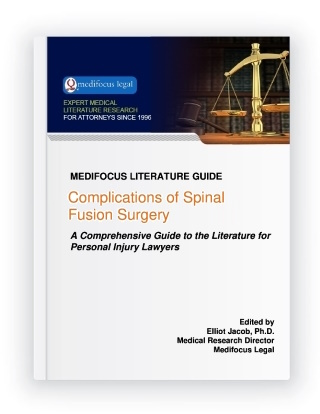
Complications of Spinal Fusion SurgeryA Comprehensive Guide to the Literature for Personal Injury Lawyers
Publisher: Medifocus Legal
Publication Date: October 30, 2025
Number of Pages: 150
A Comprehensive Guide to the Literature for Personal Injury Lawyers
Publisher: Medifocus LegalPublication Date: October 30, 2025
Number of Pages: 150
General complications of spinal fusion include infection, excessive bleeding, blood clots, poor wound healing, and adverse reactions to anesthesia. Nerve injury is another concern, potentially causing pain, weakness, or numbness. Damage to major blood vessels or the spinal cord, though rare, can lead to permanent neurological deficits. Additionally, nonunion or pseudoarthrosis — a condition where the bone segments fail to heal and fuse properly - may also develop postoperatively.
Lumbar spinal fusion complications are relatively common due to the high mechanical stress placed on the lower spine. These include persistent or recurrent back and leg pain, implant or hardware failure, and adjacent segment degeneration (ASD)— a condition where levels above or below the fusion deteriorate over time. Research suggests that up to 26% of lumbar fusion patients may develop symptomatic ASD within ten years, and reoperation rates for lumbar fusion can reach as high as 20–46%.
Cervical spinal fusion (such as anterior cervical discectomy and fusion, or ACDF) carries its own risks, including difficulty swallowing, hoarseness from recurrent laryngeal nerve injury, graft or plate displacement, and dural tears. Although generally less invasive than lumbar fusion, cervical procedures also carry a risk of adjacent segment disease and hardware failure.
Key medico-legal issues in spinal fusion surgery include:
- Failure to diagnose/treat, or delay in appropriate action, frequently cited in claims.
- Intraoperative/procedural error, including wrong-level surgery, misplaced hardware, intraoperative nerve or cord injury.
- Inadequate informed consent, wherein patients allege they were not informed of risks, alternatives or realistic outcomes.
- Catastrophic outcomes—such as new neurological deficit, paralysis or major revision surgery—are highly predictive of plaintiff verdicts and large awards.
Medical malpractice litigation involving spinal fusion surgery demands precision, depth, and authoritative medical insight. The MediFocus Literature Guide to Complications of Spinal Fusion Surgery is a unique resource designed specifically to meet the needs of medical malpractice attorneys handling these complex cases. Unlike general orthopedic references, this Guidebook focuses squarely on the full spectrum of complications associated with spinal fusion — from intraoperative errors and postoperative infections to hardware failure, adjacent segment disease, and long-term neurological injury.
Comprehensive yet practical, the Guidebook serves as a sophisticated reference for litigators seeking deeper medical clarity. For any attorney evaluating or litigating spinal fusion malpractice claims, this Guidebook is an indispensable asset — enhancing case assessment, strengthening arguments, and ultimately supporting more informed advocacy for injured patients.
The MediFocus Literature Guide to Complications of Spinal Fusion Surgery is available as a soft-cover book or a PDF download. When you order the soft-cover book, we also include the PDF format at no additional cost. Order your copy today!
Please see the side panel for ordering information.
 |
- A comprehensive bibliography of 169 journal article references indexed in MEDLINE published in well respected medical and scientific journals.
- Online access to the abstracts (summaries) of the articles.
- Online access to the free full-text version of 71 articles.
- Links to full-text sources of other articles that are available for purchase directly from individual journal publishers.
- A unique "Author Directory" consisting of the names and institutional affiliations of experts who have published and have specialized knowledge about Complications of Spinal Fusion Surgery. The "Author Directory" is a valuable resource for quickly identifying and locating experts for case reviews, opinions, and testimony.
Select examples of topics that are covered by the articles referenced in this Guidebook include:
- Skeletal risk factors for postoperative complications in older men undergoing spinal fusion surgery.
- Neurological Complications Following Anterior Lumbar Interbody Fusion (ALIF): A Systematic Review.
- ALIF vs. posterior fusion for lumbar degenerative disease: comparable efficacy but elevated risk of severe complications-a systematic review and meta-analysis.
- Vascular injuries and complications in anterior lumbar interbody fusion: an up-to-date review.
- Postoperative complications of anterior cervical discectomy and fusion: A comprehensive systematic review and meta-analysis.
- Evaluating single-level vs. multi-level lateral lumbar interbody fusion: Clinical outcomes and complications.
- Fusion rate and complications of oblique lumbar interbody fusion and transforaminal lumbar interbody fusion in the treatment of lumbar degenerative diseases: a meta-analysis.
- The Effect of Diabetes on Complications after Spinal Fusion: A Systematic Review and Meta- Analysis.
- Analysis of the Frequency of Intraoperative Complications in Anterior Lumbar Interbody Fusion: A Systematic Review.
- Complication Avoidance in Spine Surgery.
- MRI after Lumbar Spine Decompression and Fusion Surgery: Technical Considerations, Expected Findings, and Complications.
- Anterior Lumbar Interbody Fusion in Elderly Patients: Peri- and Postoperative Complications and Clinical Outcome.
- Adjacent segment degeneration after posterolateral lumbar fusion: results and complications of posterior revision surgery.
- Complications in Spinal Fusion Surgery: A Systematic Review of Clinically Used Cages.
- Predictors of airway, respiratory, and pulmonary complications following elective anterior cervical discectomy and fusion.
- Propensity-Matched Comparison of 90-Day Complications in Robotic-Assisted Versus Non- Robotic Assisted Lumbar Fusion.
- In-hospital Course and Complications of Laminectomy Alone Versus Laminectomy Plus Instrumented Posterolateral Fusion for Lumbar Degenerative Spondylolisthesis:
- Clinical Results and Complications of Endoscopic Lumbar Interbody Fusion for Lumbar Degenerative Disease: A Meta-Analysis.
- Complications following posterior cervical decompression and fusion: a review of incidence, risk factors, and prevention strategies.
- Complications and Prevention Strategies of Oblique Lateral Interbody Fusion Technique.
is available in two formats: | |
Order by Phone:To order by phone, please call: Order by Mail:To order by mail, please print and complete this Order Form | |